internettoolbox
← Back to Tools

Japanese Walking Timer

A woman walking briskly along a path through a Japanese garden with cherry blossoms, a stone lantern and a torii gate at sunrise — the Japanese walking interval method
The 3+3 Japanese walking method (Interval Walking Training) — 30 minutes outdoors.

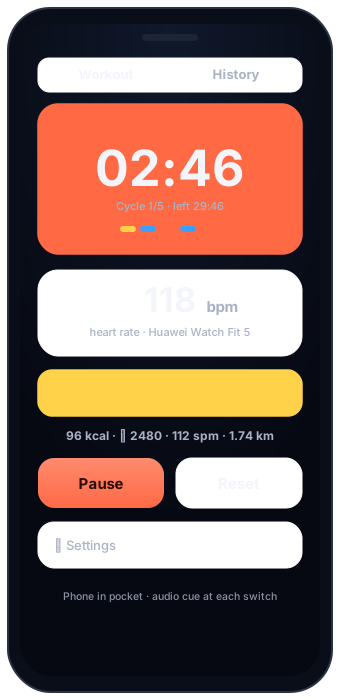
Run the 3+3 Japanese walking method with live coaching: a guided interval timer that reads your real heart rate from any Bluetooth smartwatch, tracks calories and target zones, and maps your route. Opens full-screen — phone in pocket, cue in your ears.

The Japanese Walking timer app showing a fast interval with live heart rate from a Huawei Watch Fit 5 and an on-screen speed-up alert

Coaching on your wrist — and in your pocket

  • Live heart-rate zones — on-screen "speed up / ease off" alerts keep every brisk interval on target.
  • Calories, steps & cadence — a Keytel calorie estimate plus a phone-sensor step counter.
  • GPS route, pace & distance — mapped and saved with each session.
  • Made for walking — full-screen, audio cues, and a pocket lock screen.
3′3′cycle 13′3′cycle 23′3′cycle 33′3′cycle 43′3′cycle 5FASTSLOW
One 30-minute session = 5 × (3 min brisk + 3 min slow). Repeat 4+ days a week.

The science behind Japanese walking

"Japanese walking" is the popular name for Interval Walking Training (IWT), a protocol developed by physiologists Hiroshi Nose and Shizue Masuki at Shinshu University in Matsumoto, Japan. In their landmark 5-month trial of middle-aged and older adults, published in Mayo Clinic Proceedings in 2007, the interval group — alternating 3 minutes of brisk and 3 minutes of gentle walking — improved peak aerobic capacity and thigh muscle strength and lowered resting blood pressure significantly more than a group walking the same total time at a steady, moderate pace.1

Later work from the same lab found that the amount of time spent in the high-intensity (brisk) phase is the key driver of those gains — which is exactly what this tool measures with your live heart rate.2

Why intervals beat a steady stroll

A continuous comfortable walk keeps you well below the intensity that drives cardiovascular adaptation. The 3-minute brisk bouts push you up toward your peak effort, while the easy bouts let you recover enough to repeat them — so over 30 minutes you accumulate far more high-quality training stimulus than a single steady effort, without the strain of running.

What the research links it to

Lower blood pressureGreater reductions in resting blood pressure than continuous moderate walking.
Stronger legsImproved knee extension and flexion strength in older adults.
More aerobic fitnessHigher peak aerobic capacity (VO₂peak) — a strong marker of longevity.
Low-impact & accessibleJust walking — no gym, no equipment, easy on the joints.
Time-efficient30 minutes, 4+ days a week, with measurable results in studies.
Easy to sustainVariety from the intervals makes it less monotonous than a fixed pace.

Find your brisk-interval heart rate

50%60%70%85%100%RECOVERYBRISK 70–85%TOO HARD
Aim for 70–85% of your max heart rate (≈220−age) during the fast 3 minutes — a pace where you can still talk but not sing. The app flags when you're in, under or over this zone.

Works with your watch

The app reads your real-time heart rate from any device that broadcasts it over standard Bluetooth. Turn on "Heart rate broadcast" on the watch, then tap Connect. Tested-compatible devices include:

HuaweiWatch Fit 5, Fit 5 Pro, Fit 3, Watch GT 4 / GT 5, Band 8 / 9
GarminForerunner, Venu, Fenix and most recent models
Polar · Coros · SuuntoPlus Amazfit and Wahoo sports watches
Chest strapsPolar H10, Wahoo TICKR and any BLE heart-rate strap

Note: the Apple Watch doesn't broadcast heart rate to third-party apps, and Web Bluetooth needs a Chromium browser (Chrome, Edge, Opera or Brave) — it isn't available in Safari or Firefox.

How to start, in 4 steps

  1. Warm up with 1–2 minutes of easy walking.
  2. Walk briskly for 3 minutes — fast enough that you can talk but not sing (≈70–85% of max heart rate).
  3. Slow to an easy 3 minutes to recover.
  4. Repeat the 3+3 cycle five times (30 minutes total), aiming for 4 or more sessions a week.

Tap Start the workout above to run the timer full-screen; connect a Bluetooth-broadcasting watch or chest strap to see whether each brisk interval is really in the zone. As always, check with a doctor before starting a new exercise programme if you have a heart condition.

Put your numbers in context with our BMI calculator, and estimate your target heart-rate zones from your age.

Sources

  1. Nemoto K, Gen-no H, Masuki S, Okazaki K, Nose H. Effects of high-intensity interval walking training on physical fitness and blood pressure in middle-aged and older people. Mayo Clin Proc. 2007;82(7):803–811. doi:10.4065/82.7.803
  2. Masuki S, Morikawa M, Nose H. High-intensity walking time is a key determinant to increase physical fitness and improve health outcomes after interval walking training in middle-aged and older people. Mayo Clin Proc. 2019;94(12):2415–2426. doi:10.1016/j.mayocp.2019.04.039

How it works

Japanese walking (Interval Walking Training, or IWT) alternates 3 minutes of brisk walking with 3 minutes of slow walking, repeated five times for a 30-minute session. The protocol was developed by Hiroshi Nose and Shizue Masuki at Shinshu University, whose trials linked it to lower blood pressure, stronger legs and better aerobic fitness, often beating the same time spent walking at a steady pace.

Press Start the workout to open the timer full-screen. It counts each interval and signals every switch with a beep and a spoken fast / slow cue through your earphones, so your phone can stay in your pocket. A progress strip shows where you are across the five cycles.

The difference from a plain stopwatch is the heart rate. If your watch supports heart-rate broadcasting (most Huawei, Garmin, Polar and Wahoo devices do), the tool reads your live pulse over standard Bluetooth, with no account and no app pairing, and tells you whether your brisk interval is actually in the target zone of 70 to 85 percent of your maximum heart rate. During the slow phase it tracks recovery.

Each session is scored: average and max heart rate, time spent in zone, calories (estimated with the Keytel heart-rate formula from your age, weight and sex) and, if you enable it, the GPS route from your phone. Sessions are saved locally in your browser and can be exported as CSV, JSON or a shareable summary image. Pair it with the BMI calculator and age calculator on this site to put your numbers in context.

Intervals beat steady pace: pushing into the brisk zone for 3 minutes and then recovering drives a bigger cardiovascular adaptation than walking the whole 30 minutes at one comfortable speed. That is the core finding behind the method. The watch is only a sensor, though: it broadcasts the pulse, while this page does the timing, the zone logic and the coaching. Everything runs in your browser, and your health data never leaves your phone.

Frequently Asked Questions

What is Japanese walking (the 3+3 method)?

It is Interval Walking Training: 3 minutes of brisk walking (a pace where you can't comfortably sing) alternated with 3 minutes of easy walking, repeated 5 times for 30 minutes, ideally 4 or more days a week.

Does Japanese walking actually work?

In the Shinshu University trials (Nose and Masuki), interval walkers improved blood pressure, leg strength and aerobic capacity more than steady-pace walkers over the same minutes. It is one of the most evidence-backed walking protocols.

Do I need a smartwatch?

No. The timer and audio cues work on their own. A watch only adds live heart-rate and zone feedback, and only if it supports standard Bluetooth heart-rate broadcasting, which you turn on in the watch settings.

What heart rate should I hit on the fast interval?

Roughly 70 to 85 percent of your maximum heart rate (about 220 minus your age). The tool highlights when you are in, under or over that zone. See the table below for your age band.

How long until I see results?

The studies ran about 4 months at 4 or more sessions per week. Many people notice easier breathing and faster recovery within 2 to 3 weeks.

Is my heart-rate and location data private?

Yes. The pulse comes straight from your watch over Bluetooth to your browser, and GPS is read on your phone. Nothing is uploaded, and data is stored only in your browser's local storage.

Which smartwatches work, and how do I connect one?

Any watch, band or chest strap that broadcasts heart rate over standard Bluetooth (the BLE Heart Rate Service) works. Confirmed-compatible examples include the Huawei Watch Fit 5, Watch Fit 5 Pro, Watch Fit 3, Watch GT 4 and GT 5, and Band 8/9; Garmin (Forerunner, Venu, Fenix); Polar; Coros; Suunto; Amazfit; Wahoo; and classic chest straps like the Polar H10. On the device, turn on the setting usually called 'Broadcast heart rate' or 'Heart rate broadcast', then tap Connect in the app and pick it from the list. Two caveats: the Apple Watch does not broadcast to third-party apps so it can't connect, and you need a Chromium browser (Chrome, Edge, Opera, Brave) because Web Bluetooth is not available in Safari or Firefox.

Japanese walking target heart rate by age (3+3 brisk interval)

Use these zones for the fast 3-minute interval. Recovery is the easy 3-minute phase.

AgeMax HR (≈220−age)Brisk interval (70–85%)Recovery (<60%)
30190133–162 bpmunder 114
40180126–153 bpmunder 108
50170119–145 bpmunder 102
60160112–136 bpmunder 96
70150105–128 bpmunder 90

Zones use the 220−age estimate; for a personalised maximum consider a field test. Protocol per Nose & Masuki, Shinshu University.

Tool switcher

Search and jump to any tool